Your Ultimate Guide to Baggage Rules for International Flights from USA
Navigating the complex world of baggage rules for international flights from USA can feel like a guessing game. Conflicting information and hidden fees often lead to stress at the airport. This guide cuts through the confusion, providing clear, factual information to help you pack smarter. At Triposia, we believe in empowering travelers with data, from our Airport Directory to detailed baggage policies, not sales pitches, so you can start your journey with confidence and clarity.
Understanding Carry-On vs. Checked Baggage
The first step in mastering the baggage rules for international flights from USA is knowing the difference between what you carry with you and what you check in. Each type of luggage has its own set of specific rules, dimensions, and weight limits that can vary significantly.
Feature
Carry-On Luggage
Checked Luggage
Placement
In the overhead bin or under the seat in front of you.
Stored in the aircraft's cargo hold.
Access During Flight
Accessible throughout the flight.
Inaccessible until baggage claim at your destination.
Typical Allowance
One bag plus one personal item (e.g., laptop bag).
Varies by airline and ticket class (0-2 bags typically).
Primary Concern
Size and liquid restrictions.
Weight and total number of bags.
What Qualifies as a Carry-On?
A carry-on is the bag you bring into the aircraft cabin. This typically includes one main bag (like a small roller or duffel) and one smaller personal item, such as a purse, briefcase, or laptop bag. Both items must meet the airline's size requirements to fit in the overhead compartment or under your seat. Be aware that ultra-low-cost carriers often have much stricter rules and may charge for a standard-sized carry-on.
Defining Your Checked Luggage Allowance
Checked luggage is transported in the cargo hold and is not accessible during your flight. Your checked baggage allowance, which dictates the number of bags and their maximum weight, is determined by your airline, fare class (Economy, Business, First), and sometimes your destination. This is a critical area where travelers flying from the USA often face unexpected charges if they haven't verified the rules for their specific ticket.
Navigating International Carry-On Luggage Rules
Carry-on rules are notoriously strict, especially on international routes. Adhering to size and liquid limitations is non-negotiable to avoid having to check your bag at the gate, often for a premium fee.
Standard Carry-On Luggage Size International
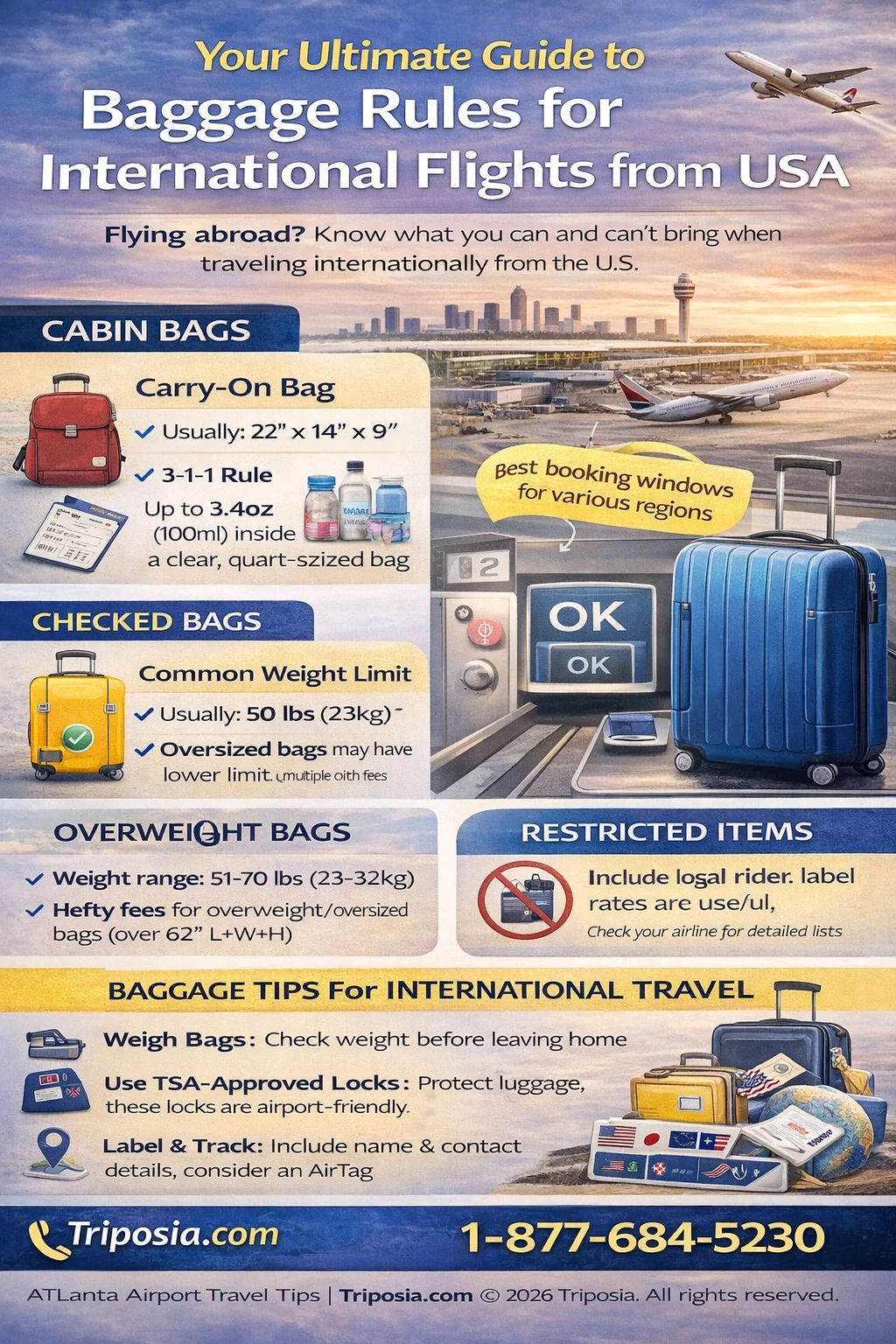
While it can vary slightly, the most common carry-on luggage size international limit is 22 x 14 x 9 inches (56 x 36 x 23 cm). It is crucial to remember that these dimensions almost always include the wheels and handles. Before you fly, always double-check the specific policy on your airline's website. A bag that is acceptable on one airline may be considered oversized on another.
The 3-1-1 International Flight Liquid Rule
The international flight liquid rules are enforced by the TSA for all flights departing from the USA. The rule is easy to remember as 3-1-1:
- Containers must be 3.4 ounces (100 milliliters) or less per item.
- All containers must fit inside 1 clear, quart-sized zip-top bag.
- Only 1 bag is allowed per passenger.
This applies to liquids, aerosols, gels, creams, and pastes. Exceptions are typically made for medically necessary liquids and infant nourishment, but you should declare them to TSA officers at the checkpoint for inspection.
Demystifying Checked Baggage Allowances
Your checked baggage allowance is where airlines differ the most. Understanding the typical limits for weight and size can help you avoid costly surprises at the check-in counter.
Common Weight and Dimension Limits
For most Airlines, the standard weight limit for a checked bag in economy class is 50 pounds (23 kilograms). The typical size limit is 62 linear inches (158 cm), calculated by adding the length, width, and height of the bag. Exceeding either of these limits will result in significant overweight or oversized baggage fees.
Decoding Airline Baggage Policies with Triposia
Understanding the vast differences in airline baggage policies is key to mastering the baggage rules for international flights from USA. This is where travel planning can become a frustrating guessing game.
Why Policies Vary Between Airlines
Baggage rules are not standardized. Each airline sets its own policies based on its business model (full-service vs. budget), the specific route (which you can explore in our Flight Routes Directory), and any codeshare partnerships. This lack of consistency is why a traveler can get a free checked bag on one flight and have to pay for a carry-on on the next. These varying airline baggage policies make it difficult to compare the true cost of a flight.
Get Clear, Data-Driven Baggage Information
At Triposia, we solve this problem. We are not a booking site, so we don't have a stake in which flight you choose. Our mission is to provide clear, accurate flight information, including complex baggage policies like the Alaska Airlines Cancellation Policy. Our data-driven travel intelligence gives you verified facts to make smart, informed decisions. With Triposia, you can easily compare what each airline truly offers, cutting through the marketing fluff to see the real details.
The Hidden Costs: Excess Baggage Fees
One of the most common travel budget-breakers is unexpected excess baggage fees. These penalties for going over the prescribed limits can often cost more than the original ticket price.
Fees for Overweight and Oversized Bags
Airlines charge steep fees for bags that are either overweight (exceeding the 50 lb/23 kg limit) or oversized (exceeding the 62 linear inches limit). These fees can range from $100 to over $200 per violation, and sometimes a bag can be penalized for being both overweight and oversized. To avoid these excess baggage fees, always weigh and measure your bags at home before you leave for the airport.
Prohibited Items for International Flights
For safety and security, certain items are restricted or banned entirely. Knowing the baggage rules for international flights from USA regarding prohibited items is essential for a smooth screening process.
Item Category
Carry-On Only
Checked Luggage Only
Prohibited Entirely
Electronics
Laptops, cameras, power banks, spare lithium batteries.
(Not Recommended)
N/A
Sharp Objects
Nail clippers, scissors with blades under 4 inches.
Knives, box cutters, large scissors.
N/A
Flammables
N/A
N/A
Lighter fluid, aerosol paint, fireworks, fuels.
Valuables
Jewelry, cash, medication, important documents.
(Not Recommended)
N/A
TSA Guidelines for International Flights
All luggage for flights departing from the USA is screened by the Transportation Security Administration (TSA). The official TSA guidelines for international flights are the ultimate authority on what you can and cannot bring. For any specific item, use the TSA's 'What Can I Bring?' tool on their website for a definitive answer. For example, all spare lithium-ion batteries and power banks must be packed in your carry-on luggage.
What Not to Pack in Your Luggage
To comply with the TSA guidelines for international flights and avoid issues, here are some key rules. Pay close attention to the list of prohibited items in checked luggage to ensure a safe flight for everyone.
- Never Pack in Any Luggage: Explosives, flammable liquids or solids (e.g., fuel, paint), disabling chemicals like pepper spray, and compressed gases.
- Always Keep in Your Carry-On: Medications, electronics with lithium batteries, jewelry, cash, and any essential or valuable documents. Never place these items in your checked bags.
Smart Packing Tips for International Travel
Strategic packing can help you stay within your limits and avoid fees. Following a few simple packing tips for international travel can make a huge difference.
Maximizing Your Luggage Space Efficiently
Here are some of the best packing tips for international travel:
- Use packing cubes to compress clothing and keep your suitcase organized.
- Roll your clothes instead of folding them to save space and minimize wrinkles.
- Wear your heaviest and bulkiest items, like boots and coats, on the plane.
Consider buying toiletries at your destination to save space and avoid complications with the international flight liquid rules. Finally, leave a little extra room for any souvenirs you plan to bring home. The last thing you want is to be searching for a list of prohibited items in checked luggage while trying to pack your new treasures.
Your Pre-Flight Baggage Checklist
Before you head to the airport, run through this final checklist to ensure you've covered all your bases regarding the baggage rules for international flights from USA.
Steps to Ensure a Smooth Departure
- Verify Airline-Specific Rules: Use a trusted, data-driven source like Triposia to get the exact baggage policy for your specific flight and fare class.
- Weigh and Measure All Bags: Use a luggage scale and tape measure at home to confirm you are within the limits.
- Check for Prohibited Items: Do a final sweep of your carry-on and checked bags for any restricted items.
- Attach Luggage Tags: Ensure every bag has a tag with your name, email, and phone number.
Take Photos: Snap quick pictures of your bags and their contents. This can be invaluable if your luggage is delayed or lost.
Tags:
About Robin McKelvie
Award-winning travel writer and broadcaster specializing in Scotland, cruise travel, and sustainable tourism.
Frequently Asked Questions
How much baggage is allowed in international flights from the USA?
This varies by airline, but typically includes one carry-on bag, one personal item, and between zero to two checked bags for economy class.
What is the 3-1-1 rule for packing?
It's a TSA rule for carry-on liquids: containers of 3.4 ounces (100ml) or less, inside one quart-sized clear bag, with one bag per passenger.
What is not allowed in baggage for international flights?
Flammables, explosives, and corrosives are banned from all luggage, while valuables and lithium batteries should only be in your carry-on.
What is the 45 minute rule?
This generally refers to the minimum time before a domestic flight that you must have checked your bags, but international cutoffs are often earlier (typically 60-90 minutes).
Can I bring a personal item in addition to a carry-on?
Yes, most major international airlines allow one personal item (like a purse or laptop bag) in addition to your standard carry-on bag.
Are the rules for electronics different for international flights?
The main rule is that devices with lithium-ion batteries, like phones, laptops, and power banks, must be in your carry-on luggage.